

An independent medical examination, often called an IME, can become an important part of a New York personal injury claim when the injured person’s medical condition, treatment, causation, disability, or future care is disputed. Although the word “independent” is commonly used, the examination is often requested by an insurance company, defense attorney, employer, or opposing party. People reviewing injury claim evidence may use a personal injury lawyer Long Island resource to understand how medical records, claim disputes, insurance issues, and damages are generally evaluated.
Quick Answer
An independent medical examination in a New York injury claim is a medical evaluation requested by an insurer, defense party, employer, or other party to review the injured person’s condition. The examiner may evaluate injury causation, treatment necessity, work restrictions, permanency, disability, no-fault benefits, or future care. An IME can affect settlement negotiations, litigation strategy, insurance benefits, medical disputes, and trial evidence, so the exam should be taken seriously and handled carefully.
Key Takeaways
- An IME is not the same as regular medical treatment.
- In New York litigation, CPLR § 3121 allows a party to serve notice for a physical, mental, or blood examination when the condition is in controversy.
- A CPLR § 3121 examination notice must specify the time, conditions, and scope of the examination, and the time must generally be at least 20 days after service of the notice.
- New York court rules also address the exchange of medical reports in personal injury and wrongful death actions.
- In New York no-fault claims, insurers may request medical examinations as part of claim verification and medical necessity review.
- Missing an IME can create serious claim problems, especially in no-fault, workers’ compensation, and litigated personal injury matters.
- An IME report may support, limit, dispute, or challenge claimed injuries, treatment, disability, permanency, and future care.
What Is an Independent Medical Examination?
An independent medical examination is a medical evaluation performed by a doctor or other medical professional who is not usually the injured person’s treating provider. The examiner is often selected by an insurance company, defense attorney, employer, or opposing party.
An IME may review:
- Diagnosis
- Injury causation
- Treatment necessity
- Medical restrictions
- Disability level
- Work capacity
- Future treatment
- Permanent impairment
- Pre-existing conditions
- Maximum medical improvement
- Relationship between the accident and symptoms
- Whether medical bills are reasonable or necessary
An IME is usually not meant to provide treatment. It is generally used to evaluate the claim, benefits, medical disputes, or litigation issues.
Why IMEs Are Requested
An IME may be requested when a party wants another medical opinion about the injury claim. This can happen in a car accident claim, no-fault claim, workers’ compensation matter, premises liability case, construction injury claim, nursing home negligence case, dog bite claim, or other personal injury matter.
An IME may be requested to answer questions such as:
- Did the accident cause the injury?
- Did the accident aggravate a pre-existing condition?
- Is the treatment medically necessary?
- Are the symptoms consistent with the diagnosis?
- Has the person reached maximum medical improvement?
- Is future treatment needed?
- Can the person return to work?
- Are restrictions temporary or permanent?
- Is surgery related to the accident?
- Is pain management still necessary?
- Are claimed limitations supported by objective findings?
A broader guide to evidence for personal injury claims can help explain why medical records, treatment history, imaging, doctor opinions, and timelines often matter when injury causation is disputed.
IME vs. Treating Doctor Visit
An IME is different from a regular doctor visit. A treating doctor usually examines the patient for diagnosis, treatment, recovery, and ongoing medical care. An IME doctor usually evaluates the person for claim-related questions.
| Issue | Treating Doctor Visit | Independent Medical Examination |
| Purpose | Treatment and recovery | Claim evaluation |
| Doctor relationship | Ongoing provider-patient relationship | Usually one-time or limited evaluation |
| Who usually requests it | Injured person or treating provider | Insurer, defense party, employer, or opposing party |
| Focus | Diagnosis, treatment, symptoms, progress | Causation, necessity, disability, restrictions, permanency |
| Result | Medical records and treatment plan | IME report or opinion |
| Role in claim | Supports medical treatment and recovery history | May support or dispute claim issues |
Both treating records and IME reports can become important in a personal injury claim.
Is an IME Really Independent?
The term “independent medical examination” can be confusing. The examiner may be expected to provide a professional medical opinion, but the exam is often requested and paid for by an insurance company, employer, or defense side.
This does not mean every IME opinion is automatically wrong. It means the report should be reviewed carefully, especially when it conflicts with treating doctor records, imaging, surgery notes, therapy findings, disability forms, or ongoing symptoms.
An IME report may be challenged when it:
- Overlooks important medical records
- Misstates the accident history
- Ignores treating provider findings
- Minimizes objective imaging
- Fails to address symptom progression
- Attributes everything to degeneration without explanation
- Uses incomplete records
- Makes broad conclusions after a brief exam
- Contradicts surgical or specialist findings
- Does not account for work restrictions
The strength of the report depends on the examiner’s qualifications, methods, records reviewed, findings, and reasoning.
IMEs in New York Personal Injury Litigation
In New York personal injury litigation, a physical or mental examination may be requested when the injured person’s condition is in controversy. CPLR § 3121 addresses physical or mental examinations and allows notice for an examination by a designated physician when the mental or physical condition is in controversy.
The notice should identify the time, conditions, and scope of the examination. The statute also provides that the time specified must generally be not less than 20 days after service of the notice.
Litigation-related IMEs may be used in claims involving:
- Car accidents
- Truck accidents
- Motorcycle crashes
- Bicycle accidents
- Pedestrian injuries
- Slip and fall accidents
- Trip and fall accidents
- Construction site injuries
- Workplace third-party claims
- Dog bites
- Nursing home negligence
- Boating accidents
- Premises liability accidents
The IME may become part of discovery, settlement evaluation, expert review, motion practice, or trial preparation.
Medical Report Exchange in New York Injury Cases
New York court rules also address medical report exchange in personal injury and wrongful death actions. Section 202.17 of the Uniform Civil Rules covers physical examinations and exchange of medical information in these cases.
This can involve medical reports from treating or examining providers, examination scheduling, additional reports, and consequences for failing to follow report exchange rules.
Medical report exchange may matter because both sides need to understand:
- What injuries are claimed
- What treatment was provided
- What diagnosis was made
- What prognosis exists
- Whether future care is expected
- Whether an IME will be requested
- Whether additional injury claims were later discovered
- Whether reports support trial testimony
Medical report exchange helps frame what the IME doctor may review and what injury issues are being disputed.
IMEs in New York No-Fault Claims
In New York motor vehicle claims, IMEs often arise in the no-fault insurance process. No-fault insurers may request medical examinations to verify claims, evaluate treatment necessity, and determine whether benefits should continue.
No-fault IME issues may involve:
- Medical bill payment
- Physical therapy
- Chiropractic care
- Pain management
- Surgery recommendations
- Diagnostic testing
- Lost wage benefits
- Medical necessity disputes
- Causation disputes
- Continued treatment disputes
In the no-fault context, missing an IME can create serious benefit problems. A no-fault insurer may argue that attendance at a properly requested examination is a condition of coverage.
A car accident attorney resource may help readers understand why no-fault benefits, medical examinations, serious injury issues, and bodily injury claims often need to be reviewed together after a crash.
IMEs in Workers’ Compensation Claims
Independent medical examinations are also common in New York workers’ compensation claims. These exams may be requested by the insurance carrier, employer, or other authorized party to evaluate work-related injury issues.
Workers’ compensation IMEs may address:
- Whether the injury is work-related
- Degree of disability
- Work capacity
- Need for continued treatment
- Permanency
- Schedule loss of use
- Maximum medical improvement
- Need for surgery
- Temporary or permanent restrictions
- Relationship between work activity and symptoms
Workers’ compensation IMEs have their own rules, forms, deadlines, and report procedures. They may also overlap with third-party personal injury claims when someone is injured at work because of another party’s negligence.
A workplace accident lawyer resource may help readers understand why workers’ compensation records, medical restrictions, IME opinions, wage records, and third-party liability evidence may all matter after a job-related injury.
What the IME Doctor May Review
The examiner may review records before, during, or after the examination. The amount of material reviewed can affect the strength of the opinion.
Records may include:
- Accident reports
- Emergency room records
- Hospital records
- Primary care records
- Specialist records
- Imaging reports
- MRI, CT, or X-ray studies
- Physical therapy notes
- Chiropractic records
- Pain management records
- Surgery records
- Prescription records
- Prior medical records
- Workers’ compensation records
- No-fault forms
- Disability forms
- Deposition transcripts
- Surveillance materials
- Job descriptions
- Work restriction notes
An IME report based on incomplete records may not tell the full story.
What Happens During an IME?
The examination usually includes a brief medical history, accident history, symptom discussion, physical examination, and review of current complaints. The exact process depends on the injury and medical specialty.
An IME may include:
- Questions about how the accident happened
- Review of current symptoms
- Questions about prior injuries
- Questions about medical history
- Questions about treatment received
- Questions about work duties
- Range-of-motion testing
- Strength testing
- Reflex testing
- Sensory testing
- Orthopedic tests
- Neurological observations
- Review of scars or visible injuries
- Functional movement observations
The exam may be much shorter than a regular treating doctor visit. The examiner may not provide treatment advice or prescribe medication.
What to Bring to an IME
The injured person should follow the instructions in the notice or scheduling letter. The needed materials may vary depending on whether the exam is for no-fault, litigation, workers’ compensation, or another claim type.
Common materials may include:
- Government-issued identification
- IME appointment notice
- List of medications
- Medical history information
- Assistive devices normally used
- Glasses, braces, cane, walker, or other support items
- Any forms requested in the notice
- Transportation receipts if reimbursement applies
- A list of current symptoms for personal reference
Medical records are often sent separately by attorneys, insurers, or claim administrators, but this depends on the case.
How to Prepare for an IME
Preparation does not mean rehearsing or exaggerating symptoms. It means understanding the purpose of the exam, reviewing the timeline, and being ready to answer questions accurately.
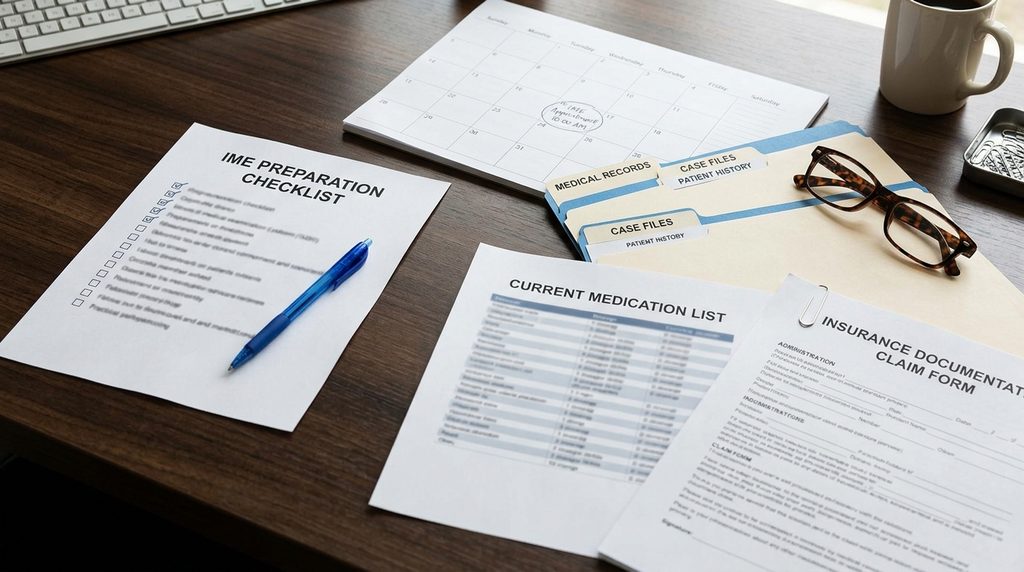
Helpful preparation may include:
- Review the accident date and basic facts.
- Review the treatment timeline.
- Understand current symptoms.
- Know which body parts were injured.
- Know prior injuries or surgeries.
- Bring required documents.
- Arrive on time.
- Be polite and cooperative.
- Answer questions clearly.
- Avoid guessing when unsure.
- Do not exaggerate symptoms.
- Do not minimize symptoms.
- Do not discuss settlement strategy.
- Note how long the exam lasted.
- Note what testing was performed.
Accuracy and consistency matter because the IME report may compare statements from the exam with medical records, deposition testimony, insurance forms, and prior claim documents.
What Not to Do During an IME
Some mistakes can create unnecessary problems. The exam may feel routine, but the report can affect benefits, settlement negotiations, and litigation.
Avoid:
- Missing the appointment without proper handling
- Arriving late without notice
- Arguing with the examiner
- Exaggerating pain
- Saying symptoms are better than they are
- Guessing about medical history
- Giving inconsistent accident details
- Discussing legal strategy
- Discussing settlement value
- Refusing reasonable parts of the exam without guidance
- Performing movements that worsen injury without saying so
- Leaving out prior injuries
- Forgetting to mention assistive devices
- Making jokes about symptoms or the claim
The safest approach is to be honest, calm, specific, and consistent.
Questions the IME Doctor May Ask
IME questions may focus on the accident, symptoms, prior medical history, treatment, work, and daily life. Some questions may seem repetitive because the examiner is comparing answers with records.
Questions may include:
- How did the accident happen?
- What body parts were injured?
- When did symptoms begin?
- Did symptoms improve or worsen?
- What treatment did you receive?
- Are you still treating?
- Have you had prior injuries to the same body part?
- Have you had surgery before?
- Did you miss work?
- Are you back to work?
- What activities are limited?
- What medication do you take?
- What future treatment has been recommended?
- Have you reached maximum medical improvement?
If the answer is unknown, it is better to say so than to guess.
IMEs and Pre-Existing Conditions
Pre-existing conditions are a common focus of IMEs. The examiner may review prior medical records, old imaging, past injuries, surgeries, arthritis, degeneration, chronic pain, or prior workers’ compensation claims.
IME reports may address whether:
- The accident caused a new injury
- The accident aggravated a prior condition
- Symptoms are related to degeneration
- Prior imaging showed similar findings
- Treatment is related to the accident
- Surgery is accident-related
- Current disability comes from the accident or prior condition
- The person had similar restrictions before the accident
A pre-existing condition does not automatically defeat an injury claim. The key question is usually what changed after the accident and whether medical evidence supports that change.
IMEs and Maximum Medical Improvement
Maximum medical improvement, or MMI, means the person has recovered as much as reasonably expected, even if pain or limitations remain. IME doctors may offer opinions about whether the injured person has reached MMI.
An IME may discuss:
- Whether active treatment is still helping
- Whether symptoms have stabilized
- Whether more improvement is expected
- Whether future care is needed
- Whether restrictions are permanent
- Whether impairment can be rated
- Whether the person can return to work
- Whether the claim should be considered medically stable
An MMI opinion can affect settlement discussions, workers’ compensation benefits, disability analysis, future medical damages, and wage loss evaluation.
IMEs and Medical Necessity
Medical necessity is a major issue in no-fault, workers’ compensation, and disputed personal injury claims. An IME doctor may review whether treatment is reasonable, necessary, and related to the accident.
Medical necessity disputes may involve:
- Physical therapy
- Chiropractic treatment
- Diagnostic imaging
- Pain management
- Injections
- Surgery
- Medication
- Specialist care
- Assistive devices
- Future therapy
- Home care
- Transportation for medical treatment
If an IME report says treatment is no longer necessary, the insurer may use that opinion to stop or deny benefits, dispute bills, reduce settlement value, or challenge future care claims.
IMEs and Work Restrictions
Work restrictions are often reviewed in IMEs, especially when the claim involves lost wages, disability, workers’ compensation, or reduced earning capacity.
An IME report may address whether the injured person can:
- Return to full duty
- Perform light duty
- Lift a certain weight
- Sit for long periods
- Stand for long periods
- Walk certain distances
- Bend or twist
- Climb ladders
- Drive
- Use tools
- Perform repetitive tasks
- Work reduced hours
- Return to the same occupation
Work restriction opinions should be compared with treating provider notes, job descriptions, physical therapy records, functional capacity findings, and actual work demands.
IMEs and Pain and Suffering
Pain and suffering can include physical pain, emotional distress, activity limitations, scarring, sleep disruption, and loss of enjoyment of life. An IME may affect pain and suffering arguments when the report comments on injury severity, objective findings, permanency, or activity limitations.
An IME report may be used to argue:
- Pain is not related to the accident.
- Symptoms are exaggerated.
- Objective findings do not support complaints.
- The person has recovered.
- Future care is not needed.
- Restrictions are unnecessary.
- The injury is temporary.
- The claimed limitations are inconsistent with the exam.
Treating records, imaging, surgery notes, therapy progress, witness observations, and daily activity evidence may help respond to these arguments.
IMEs and Settlement Negotiations
IME reports can affect settlement negotiations. A favorable IME may support injury severity, causation, future care, or work restrictions. An unfavorable IME may give the insurer a reason to reduce an offer or dispute damages.
Settlement impact may depend on:
- Examiner specialty
- Records reviewed
- Consistency with treating doctors
- Objective findings
- Whether the exam was thorough
- Whether the report addresses causation
- Whether pre-existing conditions were reviewed fairly
- Whether future care is discussed
- Whether the opinion is medically supported
- Whether other experts disagree
An IME report is one piece of evidence. It should be evaluated with the full claim file.
IMEs and Litigation Strategy
In litigation, an IME report may become part of discovery, motion practice, expert evaluation, settlement conferences, mediation, or trial preparation. The defense may use the IME doctor as an expert witness.
Litigation issues may include:
- Whether the IME notice was proper
- Whether the exam scope was appropriate
- Whether the examiner reviewed complete records
- Whether the report contains errors
- Whether the findings match the actual exam
- Whether the examiner is qualified
- Whether the conclusions are medically supported
- Whether treating doctors disagree
- Whether additional expert review is needed
Publicly available personal injury case results may provide general context, but every claim depends on its own facts, medical evidence, liability issues, insurance coverage, and litigation risks.
IMEs in Car Accident Claims
Car accident claims often involve IMEs because New York no-fault benefits and bodily injury claims both depend on medical evidence. A no-fault IME may address medical necessity for benefits, while a litigation IME may address injury causation, serious injury, permanency, and damages.
Car accident IMEs may involve:
- Neck injuries
- Back injuries
- Disc injuries
- Shoulder injuries
- Knee injuries
- Concussions
- Fractures
- Nerve symptoms
- Surgery disputes
- Physical therapy disputes
- Pain management disputes
- Lost wage benefits
- Future treatment
A car accident IME should be reviewed alongside no-fault forms, medical records, imaging, accident reports, and treating provider opinions.
IMEs in Truck Accident Claims
Truck accident claims may involve more severe injuries, commercial insurance, multiple defendants, company records, and expert review. Medical examinations may focus on whether the crash caused the claimed injuries and whether long-term damages are supported.
Truck accident IMEs may review:
- Serious trauma
- Spine injuries
- Orthopedic injuries
- Head injuries
- Surgery
- Permanent impairment
- Work capacity
- Long-term treatment
- Pre-existing conditions
- Future care needs
Because truck accident claims may involve significant damages, IME opinions may play an important role in settlement negotiations and litigation.
IMEs in Premises Liability Claims
Slip, trip, and premises liability claims often involve fall-related injuries. An IME may evaluate whether a fall caused the claimed injuries or whether symptoms came from prior degeneration, arthritis, or unrelated medical conditions.
Premises liability IMEs may involve:
- Hip injuries
- Knee injuries
- Shoulder injuries
- Wrist fractures
- Back injuries
- Neck injuries
- Head injuries
- Balance issues
- Mobility restrictions
- Surgery
- Future therapy
- Permanent limitations
A fall-related IME should be compared with incident reports, hazard photos, witness statements, medical records, and treatment history.
IMEs in Construction Accident Claims
Construction accident claims may involve serious injuries, workers’ compensation, third-party liability, jobsite evidence, and wage loss. IMEs may be used to evaluate disability, permanency, work restrictions, and causation.
Construction IMEs may focus on:
- Falls from ladders or scaffolds
- Falling object injuries
- Machinery injuries
- Vehicle accidents at work
- Lifting injuries
- Crush injuries
- Fractures
- Spine injuries
- Shoulder or knee injuries
- Permanent work restrictions
- Ability to return to construction work
A construction worker may be able to perform limited daily activities but still be unable to return to heavy labor. The IME should be evaluated in light of the actual job duties.
IMEs in Nursing Home Negligence Claims
IME issues in nursing home negligence cases may be more complicated because residents often have pre-existing medical conditions, frailty, dementia, fall risk, pressure injury risk, or chronic illness. The medical question may be whether negligence caused additional harm, accelerated decline, or worsened a condition.
IME or expert medical review may address:
- Falls
- Fractures
- Pressure injuries
- Infections
- Malnutrition
- Dehydration
- Medication injuries
- Mobility loss
- Pain
- Baseline condition
- Change after the incident
- Future care needs
Medical opinions should consider the resident’s baseline before the alleged neglect and the change afterward.
IMEs in Dog Bite Claims
Dog bite claims may involve wounds, scarring, infection, nerve damage, emotional distress, and plastic surgery needs. An IME may evaluate scarring, permanency, nerve symptoms, future treatment, and psychological impact.
Dog bite IMEs may address:
- Wound healing
- Scar visibility
- Scar sensitivity
- Nerve symptoms
- Range-of-motion limitations
- Infection complications
- Plastic surgery options
- Emotional distress
- Future scar revision
- Permanent disfigurement
Photos over time and treating provider records can be especially important in dog bite injury review.
IMEs in Boating Accident Claims
Boating accident claims may involve fractures, head injuries, drowning-related harm, propeller injuries, dock injuries, burns, or severe soft tissue trauma. An IME may evaluate whether the injury is related to the boating incident and what long-term effects remain.
Boating accident IMEs may involve:
- Orthopedic injuries
- Head trauma
- Neurological symptoms
- Scarring
- Burns
- Chronic pain
- Mobility restrictions
- Surgery
- Future rehabilitation
- Permanent limitations
The IME report should be reviewed with boating accident reports, vessel evidence, medical records, photos, witness statements, and treatment history.
What Happens After an IME?
After the exam, the doctor usually prepares a report. The report may be sent to the insurance company, defense attorney, workers’ compensation carrier, no-fault insurer, or other requesting party.
The report may include:
- Records reviewed
- Accident history
- Medical history
- Current complaints
- Physical exam findings
- Diagnosis
- Causation opinion
- Treatment necessity opinion
- Disability opinion
- Work capacity opinion
- MMI opinion
- Permanency opinion
- Future care opinion
- Restrictions
- Conclusions
The report should be checked for accuracy. Errors in accident history, records reviewed, symptoms, exam findings, or conclusions may need to be addressed.
How to Respond to an Unfavorable IME Report
An unfavorable IME report does not automatically end a claim. It should be reviewed carefully against the medical records, treating doctor opinions, imaging, therapy notes, and facts of the accident.

Possible response evidence may include:
- Treating doctor narrative report
- Updated medical records
- Imaging comparison
- Surgical records
- Physical therapy progress notes
- Pain management records
- Specialist opinions
- Work restriction notes
- Functional capacity evaluation
- Prior medical records
- Daily activity evidence
- Witness observations
- Clarification of report errors
A strong response focuses on evidence, not emotion.

Practical IME Review Chart
| IME Issue | Why It Matters | Useful Evidence |
| Causation | Determines whether the injury is connected to the accident | Medical records, imaging, accident reports, doctor opinions |
| Medical necessity | Affects treatment payment and future care disputes | Treatment notes, prescriptions, therapy records, specialist reports |
| Work restrictions | Affects lost wage and earning capacity claims | Work notes, job descriptions, employer records |
| Permanency | Supports long-term damages and disability analysis | MMI reports, impairment findings, imaging, specialist opinions |
| Pre-existing conditions | May be used to dispute claim value | Prior records, before-and-after comparison, causation opinions |
| Exam accuracy | Errors can affect settlement and litigation | Appointment notes, report review, medical timeline |
| No-fault benefits | Missed exams can affect benefit payment | IME notices, attendance proof, no-fault correspondence |
| Settlement value | IME opinions may influence insurer offers | Complete claim file, treating records, expert review |
Common IME Mistakes
Some mistakes can create avoidable problems.
Common mistakes include:
- Missing the exam without proper handling
- Arriving late
- Not reading the notice carefully
- Guessing about medical history
- Exaggerating symptoms
- Minimizing symptoms
- Forgetting prior injuries
- Giving inconsistent accident details
- Arguing with the examiner
- Discussing settlement strategy
- Failing to mention all affected body parts
- Not using assistive devices normally used
- Not documenting what happened at the exam
- Ignoring errors in the IME report
- Assuming the report cannot be challenged
The best approach is accurate, calm, and consistent communication.
How to Keep IME Records Organized
IME documents should be organized with the rest of the claim file. This makes it easier to evaluate how the report fits into the case.
Useful documents to keep include:
- IME appointment notice
- Proof of attendance
- Transportation receipts
- Notes about exam length
- Notes about tests performed
- List of questions asked
- IME report
- Treating provider response
- Updated medical records
- No-fault letters
- Workers’ compensation letters
- Insurance correspondence
- Court notices
- Settlement letters
The IME should be treated as part of the medical and claim evidence timeline.
Deadlines Still Matter
IME disputes do not pause legal deadlines. New York Courts lists three years for many car accident, slip and fall, and negligence-based personal injury claims. Different or shorter deadlines may apply to wrongful death, public entity claims, no-fault claims, workers’ compensation matters, and other case types.
Timing issues may involve:
- IME appointment dates
- No-fault verification requests
- Medical bill deadlines
- Lost wage submissions
- Workers’ compensation deadlines
- Litigation discovery deadlines
- Expert disclosure dates
- Court filing deadlines
- Settlement release timing
- Public entity notice requirements
A claim may involve both medical timing and legal timing at the same time.
When Legal Guidance May Be Useful
Legal guidance may be useful when an IME is scheduled, the location or scope seems unreasonable, multiple exams are requested, the insurer threatens denial, benefits are stopped after an IME, the report contains errors, the examiner disputes causation, or the injured person has serious injuries, surgery, pre-existing conditions, or work restrictions.
An IME review may require medical records, no-fault letters, workers’ compensation documents, exam notices, prior records, imaging, treating provider reports, insurance correspondence, wage records, and litigation deadlines.
People researching local support may review a Long Island injury law office when looking for personal injury claim information.
FAQs About Independent Medical Examinations in New York Injury Claims
What is an independent medical examination in a New York injury claim?
An independent medical examination is a medical evaluation requested by an insurer, defense party, employer, or opposing party. The examiner may review injury causation, treatment necessity, work restrictions, disability, permanency, or future care.
Is an IME the same as a regular doctor visit?
No. A regular doctor visit is usually for treatment and recovery. An IME is usually for claim evaluation. The IME doctor typically does not provide ongoing care or treatment planning like a treating provider.
Can an IME affect no-fault benefits?
Yes. In New York no-fault claims, insurers may request medical examinations as part of claim verification and medical necessity review. Missing a properly requested no-fault IME can create serious benefit problems.
What should someone say during an IME?
Answers should be accurate, specific, and consistent. The injured person should explain symptoms honestly, avoid exaggeration, avoid minimizing pain, disclose prior injuries truthfully, and avoid guessing when unsure.
Can an unfavorable IME report be challenged?
Yes. An unfavorable IME report may be challenged with treating doctor records, imaging, specialist reports, surgery notes, therapy records, work restriction notes, prior medical records, and evidence showing errors or incomplete review.
Final Thoughts
Independent medical examinations can strongly affect New York personal injury claims because they may influence medical benefits, insurance decisions, settlement value, work restrictions, future care, litigation strategy, and trial evidence. An IME is not regular treatment, and the report should be reviewed carefully with the full medical record. The strongest approach is to attend properly scheduled exams, answer questions accurately, keep records organized, review the report for errors, and compare the IME opinion with treating provider evidence