

Choosing the right scrub pants involves more than selecting a size. Body proportions, rise, waistband construction, hip and thigh room, leg shape, stretch, inseam, and pocket placement can all affect how women’s scrub pants fit and perform during a workday. Work demands matter just as much. A professional who spends a shift walking and bending may need different features from someone who spends much of the day seated.
There is also no single scrub-pant silhouette that works best for every body type. Joggers, tapered, straight-leg, wide-leg, flare, and yoga-waist styles each distribute fabric differently and create different fit considerations. The most practical approach is to understand personal proportions and then match them with the movement, comfort, storage, and appearance requirements of the job.
Quick Answer
The best way to choose women’s scrub pants is to evaluate body proportions and work requirements together.
- Waist and rise: Choose a waistband and rise that remain comfortable while standing, sitting, and bending.
- Hips and thighs: Allow enough room for normal movement without excessive fabric.
- Leg silhouette: Choose between jogger, tapered, straight, wide-leg, or other styles based on movement and preferred appearance.
- Stretch: Useful for bending, walking, reaching, and repeated movement.
- Inseam: Match the pant length to height, leg proportions, footwear, and the intended silhouette.
- Pockets: Consider location, depth, accessibility, and the amount of weight normally carried.
- Work activity: Active jobs may prioritize mobility, while seated work may make rise and waistband comfort more important.
- Environment: Fabric weight, breathability, and layering can influence comfort.
- Professional appearance: Fit and proportion matter as much as the silhouette itself.
- Durability: Frequent laundering makes fabric recovery and construction important.
The goal is not to find pants that conform to a particular body-shape rule. It is to identify where the garment needs room, where it needs stability, and which features support the actual workday.
Why Body Proportions Matter When Choosing Scrub Pants
Two women can wear the same nominal size and have very different proportions.
One person may have:
- A relatively narrow waist and fuller hips
- A longer torso
- Longer legs
- More thigh volume
- A shorter inseam
Another person may have the same waist measurement but different proportions through the hips, thighs, and legs.
This is why numerical size alone cannot determine whether scrub pants will fit comfortably.
Measurements That Matter
When evaluating scrub pants, consider:
- Waist
- Hips
- Thighs
- Rise
- Inseam
- Calf
- Overall height
These measurements help identify where a garment may feel restrictive or excessively loose.
What Should a Good Fit Feel Like?
A properly fitting pair of scrub pants should remain comfortable through ordinary movement.

Look for:
- A stable waistband
- Comfortable seated fit
- Adequate hip room
- Sufficient thigh room
- Unrestricted knee movement
- Appropriate calf and ankle room
- A suitable inseam
The pants should not require constant adjustment throughout the shift.
Test the Pants in Motion
Standing in front of a mirror is only the beginning.
Try:
- Sitting down
- Standing up
- Walking
- Bending
- Squatting
- Taking a long step
- Turning the torso
- Sitting for several minutes
Movement reveals fit issues that may not be visible while standing still.
How Does the Waistband Affect Fit?
The waistband determines how securely the pants sit and how much pressure is created around the waist.
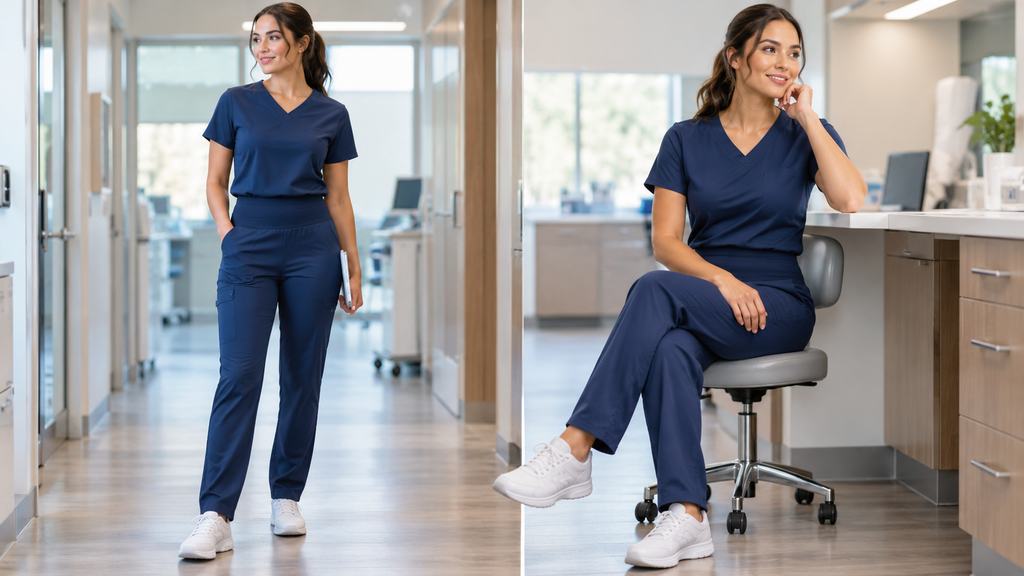
Common constructions include:
- Full elastic
- Yoga waistband
- Drawstring
- Elastic with drawstring
- Structured waistband with stretch
The best choice depends on personal preference, body proportions, and work activity.
What Makes a Waistband Comfortable?
A comfortable waistband should:
- Stay in place
- Avoid excessive pressure
- Remain comfortable while sitting
- Allow bending
- Work with the pant’s rise
A waistband that feels comfortable while standing may feel very different when seated.
What Is the Best Rise for Different Body Proportions?
Rise describes the distance between the crotch and waistband.
The appropriate rise depends on:
- Torso length
- Hip proportions
- Waist position
- Personal preference
- Waistband construction
A Shorter Rise
A shorter rise may create tension when sitting or bending if it does not provide enough room.
Potential signs include:
- Pulling around the hips
- Waistband pressure
- Reduced seated comfort
A Longer Rise
A longer rise can create excess fabric or bunching if it does not match the wearer’s proportions.
The correct rise should remain stable during both standing and movement.
How Should Women With Fuller Hips Choose Scrub Pants?
Women with more hip volume relative to the waist may need to pay particular attention to the relationship between the waistband and hip area.
Look for:
- Adequate hip room
- Comfortable thigh dimensions
- A rise that does not pull
- A waistband that remains secure
- Pockets that lie relatively flat
If the waist fits but the hips feel restrictive, changing the silhouette may be more useful than automatically choosing a larger size.
Why Sizing Up Is Not Always the Solution
Increasing the overall size can create:
- Excess waistband room
- Longer inseam
- Additional lower-leg fabric
The issue may be the cut rather than the size.
How Should Women With a Straighter Waist-to-Hip Proportion Choose Scrub Pants?
Women with less difference between waist and hip measurements may find several waistband constructions comfortable.
Important considerations include:
- Waistband stability
- Rise
- Overall leg shape
- Stretch
- Pocket placement
A flexible waistband can accommodate movement, while the correct rise helps keep the pants positioned comfortably.
The focus should remain on actual measurements rather than relying on broad body-shape categories.
How Should Women With Fuller Thighs Choose Scrub Pants?
Thigh room is especially important for movement.
Check whether the pants remain comfortable when:
- Walking
- Sitting
- Bending
- Squatting
- Taking longer strides
Look for excessive horizontal pulling around the upper legs.
Consider Different Leg Silhouettes
A wider or more relaxed leg can provide additional room below the hips.
However, the upper portion of the pants still needs to fit correctly.
A wide-leg design does not automatically solve a tight hip or thigh fit.
How Should Women With Slimmer Legs Choose Scrub Pants?
Women with slimmer legs may prefer several silhouettes depending on personal preference.
Joggers and tapered pants can create a more defined lower-leg profile.
Straight-leg pants provide a more traditional shape.
Wide-leg pants provide greater volume and a more relaxed appearance.
The key consideration is proportion.
The pant should maintain its intended shape without excessive fabric bunching around the knees or ankles.
How Does Height Affect Scrub Pant Selection?
Height primarily affects proportion and length.
Women of different heights may need different inseams even when waist and hip measurements are similar.
Petite Proportions
Potential considerations include:
- Shorter inseam
- Knee placement
- Rise
- Overall garment proportion
A pant that is too long can alter the intended silhouette.
Taller Proportions
Potential considerations include:
- Longer inseam
- Rise
- Knee placement
- Hem position
A short inseam can make an otherwise correctly fitting pant appear unintentionally cropped.
Why Is Inseam So Important?
Inseam affects both function and appearance.
The correct length should work with:
- Height
- Leg proportions
- Footwear
- Pant silhouette
- Workplace requirements
A jogger, wide-leg, and tapered pant can all have the same nominal inseam but appear differently because their hems are constructed differently.
What Happens When Scrub Pants Are Too Long?
Excessive length can:
- Drag against the floor
- Fold around footwear
- Create excess fabric
- Change the intended silhouette
What Happens When They Are Too Short?
A short inseam can:
- Change the appearance of the pants
- Expose more ankle than intended
- Alter the intended proportions
How Does Stretch Help Different Body Types?
Stretch can provide additional flexibility across different body proportions.
It can be particularly useful around:
- Waist
- Hips
- Thighs
- Knees
- Calves
However, stretch should complement appropriate sizing.
It should not be used as a reason to choose a garment that is fundamentally too small.
What About Fabric Recovery?
Recovery is also important.
After stretching, the fabric should move back toward its intended shape.
Repeated movement around the knees, hips, and seat can otherwise contribute to changes in fit or appearance over time.
How Do Jogger Scrub Pants Fit Different Body Types?
Joggers generally narrow toward the ankle.
They can create a contemporary silhouette while reducing excess fabric around the lower leg.
However, women should pay particular attention to:
- Calf fit
- Ankle opening
- Cuff construction
- Thigh room
- Knee mobility
A jogger that fits well around the waist can still feel restrictive around the calves.
How Do Tapered Scrub Pants Fit Different Body Types?
Tapered pants gradually narrow toward the lower leg.
They can provide a streamlined appearance without the more pronounced ankle profile associated with some joggers.
Important areas to evaluate include:
- Hips
- Thighs
- Knees
- Calves
- Ankle
Tapered pants can work well for women who want controlled leg volume without a tight ankle cuff.
How Do Wide-Leg Scrub Pants Fit Different Body Types?
Wide-leg pants provide greater width through the lower leg.
They may appeal to women who prefer:
- More lower-leg room
- Less close-fitting fabric
- A relaxed silhouette
However, the wider lower leg does not determine the fit of the waist, hips, or thighs.
Watch the Proportions
The overall uniform should remain balanced.
Consider how the wide-leg pant works with the scrub top, footwear, and overall garment length.
How Do Yoga-Waist Scrub Pants Fit Different Body Types?
Yoga-waist pants are primarily defined by their broad waistband.
The wider waistband can distribute pressure over a larger area.
Potential benefits include:
- Smooth waist coverage
- Flexible fit
- Reduced concentration of pressure
- A secure feel
However, women should still evaluate:
- Rise
- Hip room
- Thigh room
- Leg shape
- Inseam
A comfortable waistband does not guarantee a comfortable pant.
Which Scrub Pant Style Is Best for Curvier Body Proportions?
There is no single best style for every curvier body type.
Instead, look for:
- Adequate hip room
- Comfortable thigh dimensions
- A stable waistband
- Appropriate rise
- Useful stretch
A tapered or jogger silhouette may work well for one woman, while another may prefer a wider leg.
The fit through the waist, hips, and thighs matters more than the label attached to the silhouette.
Which Scrub Pant Style Is Best for a More Relaxed Fit?
Women who prefer a less close-fitting garment may consider:
- Wide-leg pants
- Relaxed straight-leg pants
- Some yoga-waist designs
The objective is to provide additional room without creating excessive fabric around the waist or hips.
A relaxed fit should still look intentional and remain practical during movement.
Which Scrub Pant Style Is Best for a Streamlined Appearance?
Tapered and jogger styles often create more controlled lower-leg proportions.
Straight-leg pants can also provide a clean, traditional silhouette.
A streamlined appearance ultimately depends on:
- Correct sizing
- Fabric drape
- Leg proportions
- Hem length
- Waistband position
A narrow silhouette is not automatically more polished if it creates visible pulling.
How Should Work Needs Influence Scrub Pant Selection?
Body proportions are only half the decision.
The other half is the job.
Consider:
- How much walking occurs
- How frequently the wearer bends
- How much time is spent sitting
- Whether climbing stairs is common
- How much equipment is carried
- Whether the environment is warm or cool
- Whether additional layers are required
A pant that works well for one role may not be ideal for another.
What Scrub Pants Are Best for High-Movement Jobs?
High-movement work may involve:
- Frequent walking
- Bending
- Reaching
- Squatting
- Repeated sitting and standing
Prioritize:
- Stretch
- Hip and thigh room
- Knee mobility
- Stable waistband
- Secure pockets
- Appropriate inseam
Joggers and tapered pants can appeal to women who prefer a controlled lower-leg profile, while wider styles can work for those who prefer more room.
What Scrub Pants Are Best for Jobs With Long Periods of Sitting?
For seated work, pay particular attention to:
- Rise
- Waistband
- Hip room
- Thigh room
- Back pocket placement
Sit down and lean forward when testing the pants.
Check whether the waistband:
- Presses uncomfortably
- Slides
- Bunches
- Gaps
- Remains stable
A comfortable standing fit does not guarantee comfortable seated wear.
What Scrub Pants Are Best for Nurses?
Nursing can involve significant movement throughout a shift.
Potential priorities include:
- Stretch
- Comfortable rise
- Stable waistband
- Hip and thigh room
- Practical pockets
- Durable construction
- Suitable inseam
The appropriate silhouette depends on the nursing environment and the individual professional’s preferences.
What Scrub Pants Are Best for Dental Professionals?
Dental professionals may spend substantial time sitting, leaning, turning, and reaching.
Potential priorities include:
- Comfortable seated fit
- Appropriate rise
- Flexible fabric
- Comfortable waistband
- Adequate hip and thigh room
Pocket placement should also be evaluated because large or heavily loaded pockets can become uncomfortable while seated.
What Scrub Pants Are Best for Veterinary Professionals?
Veterinary work may involve frequent bending, crouching, walking, and reaching.
Potential priorities include:
- Flexible fabric
- Comfortable knee movement
- Adequate thigh room
- Secure pockets
- Stable waistband
- Appropriate inseam
The best silhouette depends on the specific responsibilities of the role.
What Scrub Pants Are Best for Medical Students?
Medical students may move between classrooms, clinical settings, and different rotations.
A versatile pair of pants may therefore be useful.
Consider:
- Comfortable everyday fit
- Practical pockets
- Easy-care fabric
- Professional appearance
- Compatibility with multiple tops
Versatility can be more useful than choosing a highly specialized silhouette.
How Do Pocket Needs Affect Scrub Pant Selection?
Pockets can influence both function and fit.
Common storage requirements may include:
- Pens
- Identification
- Small approved tools
- Communication devices
- Other lightweight essentials
Consider:
- Pocket depth
- Opening
- Position
- Security
- Weight capacity
Do More Pockets Make Better Scrub Pants?
Not necessarily.
More pockets can create additional fabric and visual bulk.
A smaller number of well-positioned pockets may be more useful than several compartments that are rarely used.
How Does Pocket Placement Affect Different Body Proportions?
Pocket position can affect how the pants appear and feel.
For example, pockets positioned around the hip can become more noticeable if heavily loaded.
Large cargo pockets can also change the visual balance of the lower body.
The goal is not to avoid particular pocket styles based on body type. Instead, evaluate whether the pocket sits comfortably and maintains the intended garment shape.
How Does Pocket Weight Affect Comfort?
Pocket contents add weight.
Heavy contents can pull on:
- Waistbands
- Hips
- Side seams
- Pocket attachment points
This can change how the pants hang.
When testing scrub pants, use representative lightweight items if storage is an important part of the workday.
How Does Fabric Affect Different Body Types?
Fabric characteristics can change how a pant fits and moves.
Important factors include:
- Stretch
- Recovery
- Weight
- Drape
- Surface feel
- Durability
A structured fabric can maintain a more defined silhouette.
A fluid fabric may move more freely.
A stretchy fabric may accommodate movement more easily.
No individual characteristic should be evaluated in isolation.
How Does Fabric Drape Affect Scrub Pant Appearance?
Drape influences how the fabric hangs around the body.
This can be particularly noticeable with:
- Wide-leg pants
- Straight-leg pants
- Flare pants
A fluid fabric may create softer folds.
A more structured fabric may maintain stronger lines.
The appropriate choice depends on the desired appearance and work environment.
How Does Fabric Weight Affect Work Comfort?
Fabric weight can influence how substantial the pants feel.
Lightweight construction may be useful in warmer environments.
A more substantial fabric may provide greater structure or coverage.
Consider:
- Workplace temperature
- Activity level
- Climate
- Layering
- Personal preference
The heaviest or lightest fabric is not automatically the best choice.
How Does Breathability Affect Scrub Pant Selection?
Breathability can become more important in warm or physically active environments.
Consider:
- Fabric construction
- Fabric weight
- Fit
- Activity
- Layering
A wide-leg silhouette does not automatically mean the fabric itself is more breathable.
Breathability is primarily influenced by the fabric and garment construction.
How Should Women Choose Scrub Pants for Long Shifts?
Long shifts can make minor fit problems increasingly noticeable.
Prioritize:
- Comfortable waistband
- Appropriate rise
- Adequate hip and thigh room
- Useful stretch
- Suitable fabric weight
- Practical pockets
- Correct inseam
The pants should remain comfortable after several hours, not just during a short fitting.
How Should Women Choose Scrub Pants for Warm Work Environments?
For warmer environments, consider:
- Lightweight fabrics
- Appropriate breathability
- Comfortable fit
- Reduced unnecessary layering
However, fabric weight is not the only factor.
A close-fitting garment may feel warmer than a more relaxed garment made from the same fabric.
How Should Women Choose Scrub Pants for Cooler Work Environments?
Cooler environments can make layering more relevant.
Consider whether the pants work comfortably with:
- Base layers
- Jackets
- Other approved garments
A garment that fits perfectly on its own may feel restrictive when additional layers are introduced.
How Does Footwear Affect Scrub Pant Choice?
Footwear can influence how the hem sits and how the overall uniform looks.
Consider:
- Shoe height
- Sole thickness
- Toe shape
- Amount of ankle coverage
- Pant length
This is particularly important with wide-leg and flare styles because their larger hems can interact more visibly with footwear.
How Should Women Choose Scrub Pants for Different Workplace Dress Codes?
Workplace requirements should be checked before choosing a style.
Some workplaces may specify:
- Colors
- Silhouettes
- Coverage
- Uniform combinations
- Logo requirements
- Garment standards
Personal preference should work within those requirements.
A comfortable pant is not useful if it does not meet the workplace’s uniform expectations.
How Should Women Compare Different Scrub Pant Silhouettes?
Use the same criteria for each option.
| Factor | Jogger | Tapered | Wide-Leg | Yoga Waist |
| Primary feature | Narrow lower leg | Gradual narrowing | Greater lower-leg volume | Broad waistband |
| Lower-leg profile | Close | Streamlined | Roomier | Depends on leg design |
| Main fit consideration | Calf and ankle | Thigh and calf | Length and proportion | Waist and rise |
| Movement | Depends on fabric and cut | Depends on fabric and cut | More lower-leg room | Depends on leg cut |
| Appearance | Contemporary | Streamlined | Relaxed/distinctive | Smooth waist profile |
| Best tested by | Walking and bending | Full-leg movement | Inseam and movement | Sitting and standing |
This comparison demonstrates why these styles should not be treated as direct substitutes.
How Should Women Choose Between Comfort and Appearance?
Comfort and professional appearance can coexist.
Start with:
- Fit
- Movement
- Waistband comfort
- Fabric
- Storage
- Silhouette
- Overall appearance
A stylish silhouette that creates constant pulling or adjustment is unlikely to be practical.
Likewise, an extremely loose garment may be comfortable but may not provide the desired professional appearance.
The objective is balance.
How Should Women Build a Scrub Pant Wardrobe Around Their Work?
A practical wardrobe can include more than one silhouette.
For example:
Active workday
A stretch-focused jogger or tapered pant.
Seated workday
A comfortable rise and flexible waistband.
Warm workday
A lightweight, breathable construction.
Style variety
A wide-leg or alternate silhouette.
This does not mean every professional needs four different styles. The wardrobe should reflect actual work requirements and frequency of use.
How Can Women Choose Affordable Scrub Pants Without Sacrificing Fit?
Price should be evaluated alongside expected use.
Consider:
- Initial cost
- Frequency of wear
- Fabric durability
- Care requirements
- Versatility
- Construction
- Comfort
An inexpensive pair that is rarely worn because of poor fit may provide less value than a moderately priced pair that becomes a reliable everyday option.
How Important Is Durability?
Scrub pants can be subjected to frequent laundering and repeated movement.
Pay attention to:
- Waistband construction
- Pocket attachment
- Seam quality
- Fabric recovery
- Surface durability
A pant that maintains its shape through repeated use can provide better practical value.
How Does Care Affect Scrub Pant Longevity?
Follow the manufacturer’s care instructions for each garment.
Consider:
- Washing temperature
- Drying method
- Bleach restrictions
- Ironing
- Special care requirements
The Federal Trade Commission explains that covered apparel generally requires care information that gives consumers instructions for ordinary care. FTC Care Labeling Rule
Appropriate care can help preserve the garment’s appearance and construction.
What Are Common Scrub Pant Fit Problems?
Waist Too Tight
May create pressure, especially when sitting.
Waist Too Loose
May cause the pants to shift during movement.
Rise Too Short
Can create pulling around the hips and waist.
Rise Too Long
Can cause bunching or excess fabric.
Hips Too Tight
May restrict movement.
Thighs Too Tight
Can create tension while walking or bending.
Calves Too Tight
Can make tapered and jogger styles uncomfortable.
Inseam Too Long
Can create excess fabric around footwear.
Inseam Too Short
Can change the intended silhouette.
Identifying the specific problem is more useful than simply deciding that the entire garment is the wrong size.
How Can Women Determine Whether to Change Size or Silhouette?
Use the location of the fit problem as a guide.
If the waist is too tight and everything else fits:
Consider a different waistband construction or size.
If the waist fits but the hips are tight:
Look for a different cut with more hip room.
If the thighs are tight but the waist fits:
Consider a more relaxed leg silhouette.
If the lower leg is restrictive:
Consider a less tapered style.
If the garment is comfortable but too long:
Look for a different inseam.
This approach can prevent unnecessary changes to areas that already fit correctly.
How Should Women Test Scrub Pants Before Buying?
A structured fitting process can make comparison easier.
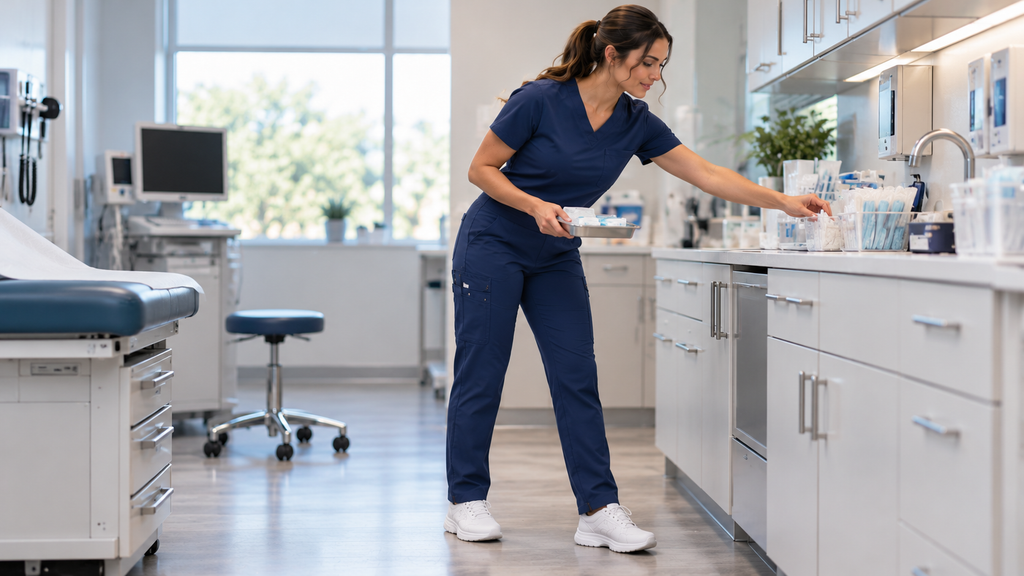
Step 1: Check the Waistband
Stand and sit.
Step 2: Check the Rise
Bend forward and sit.
Step 3: Check the Hips and Thighs
Walk, bend, and squat.
Step 4: Check the Knees
Perform normal movements.
Step 5: Check the Lower Leg
Walk and evaluate calf and ankle comfort.
Step 6: Check the Inseam
Wear the footwear normally used at work.
Step 7: Check the Pockets
Add representative lightweight items.
Step 8: Evaluate the Complete Uniform
Wear the scrub top normally paired with the pants.
The goal is to determine how the garment performs as workwear rather than as a static piece of clothing.
A Practical Body Proportion and Work Needs Guide
| Consideration | What to Prioritize |
| Fuller hips | Hip room, rise, waistband stability |
| Fuller thighs | Thigh ease, stretch, comfortable leg cut |
| Longer legs | Appropriate inseam and rise |
| Shorter legs | Petite proportions, inseam, knee placement |
| Long torso | Rise and waistband position |
| Shorter torso | Rise and waistband proportions |
| High-movement work | Stretch, mobility, secure waistband |
| Seated work | Rise, waistband, hip comfort |
| Warm environment | Lightweight construction and breathability |
| Heavy storage needs | Practical pocket capacity and distribution |
| Layering | Comfortable fit under additional garments |
These are practical evaluation points rather than rigid body-type rules.
Women’s Scrub Pants Selection Checklist
Before purchasing a pair, ask:
Fit
- Does the waistband stay in place?
- Is the rise comfortable?
- Do the hips have enough room?
- Are the thighs comfortable?
- Can the knees bend freely?
- Is the calf comfortable?
Movement
- Can you walk naturally?
- Can you bend?
- Can you squat?
- Can you sit comfortably?
- Can you take a long step?
Function
- Are the pockets useful?
- Can they hold the items normally carried?
- Does pocket weight affect the garment?
Appearance
- Does the silhouette look intentional?
- Is the hem at an appropriate length?
- Does the pant work with the scrub top?
Work Environment
- Is the fabric weight appropriate?
- Is breathability sufficient?
- Will layering be required?
- Does the garment meet workplace requirements?
Long-Term Value
- Is the price reasonable?
- Is the garment versatile?
- Is it easy to care for?
- Is the construction appropriate for repeated wear?
Final Thoughts
Choosing scrub pants for different body types and work needs is ultimately a matter of matching fit, proportions, movement, and function.
Women should not feel limited to a particular scrub-pant silhouette because of a generalized body-shape category. Instead, examine where the garment needs additional room, where it needs stability, and which features matter most during the workday. Waistband construction, rise, hip and thigh room, stretch, inseam, pockets, and fabric all contribute to the final fit.
Women exploring women’s scrub pants can evaluate jogger, tapered, wide-leg, and other silhouettes according to their own proportions and preferences. Those looking for comfortable scrub pants should pay particular attention to how the waistband, rise, hips, thighs, and knees behave during movement rather than judging comfort while standing still.
The complete uniform matters as well. Pairing the right pants with women’s medical scrubs allows professionals to consider the relationship between tops, pants, fabric, color, storage, and overall appearance.
The most practical approach is simple: measure the body, understand the work, test the garment in motion, and choose the silhouette that solves the actual fit and performance requirements.
Frequently Asked Questions
What are the best scrub pants for different body types?
There is no universally best scrub pant for a particular body type. Focus on measurements and proportions, including waist, hips, thighs, rise, and inseam. Then choose a silhouette that provides adequate room and stability where needed while supporting the movements required during work.
Are jogger scrub pants good for women with fuller thighs?
Joggers can work well when they provide sufficient room through the hips and thighs and do not become restrictive around the calves or ankles. Stretch can also support movement, but the garment should still be correctly sized.
Are wide-leg scrub pants more comfortable?
Wide-leg pants provide more room through the lower leg, which some women may prefer. However, comfort also depends on the waistband, rise, hips, thighs, fabric, and inseam. A wider leg alone does not guarantee better overall comfort.
What scrub pant style is best for long shifts?
The best style depends on the movements and conditions of the job. Long-shift comfort often requires a stable waistband, comfortable rise, adequate hip and thigh room, useful stretch, suitable fabric weight, and an appropriate inseam.
How should scrub pants fit around the waist and hips?
The waistband should remain secure without excessive pressure, while the hips should have enough room for walking, sitting, bending, and squatting. If the waist fits but the hips are restrictive, a different cut may be more appropriate than simply choosing a larger size.
Should scrub pants be loose or fitted?
They should provide enough room for normal movement without excessive fabric. The appropriate amount of ease depends on the intended silhouette, body proportions, fabric stretch, and work requirements.
How do I choose the right inseam for women’s scrub pants?
Consider height, leg proportions, rise, pant silhouette, and footwear. The inseam should prevent dragging or excessive bunching while maintaining the intended appearance of the garment.