

Healthcare professionals spend much of the workday moving, standing, reaching, bending, and interacting with patients and colleagues. A practical uniform wardrobe needs to accommodate those demands while remaining comfortable, professional, and easy to maintain.
Building that wardrobe is about more than purchasing several sets of scrubs. The most useful approach considers the complete workday, including base layers, scrub tops and pants, jackets, accessories, storage, laundry requirements, workplace dress codes, and the amount of clothing needed between wash cycles.
Key Takeaways
- A practical healthcare wardrobe should be built around the demands of the individual’s role and work environment.
- Multiple sets of scrubs make it easier to manage frequent shifts and laundry.
- Scrub tops and pants should provide comfortable movement without excessive looseness.
- Fabric selection can influence breathability, stretch, durability, and long-shift comfort.
- Layering can help professionals adapt to changing indoor temperatures.
- A lightweight scrub jacket can provide additional coverage without excessive bulk.
- Pockets should be selected based on actual storage needs rather than pocket count alone.
- Healthcare accessories such as nursing bags and stethoscope cases can improve organization.
- Workplace uniform policies should be checked before purchasing colors, styles, or specialty garments.
- A well-planned wardrobe can reduce last-minute clothing decisions and make routine workdays easier.
What Is a Healthcare Uniform Wardrobe?
A healthcare uniform wardrobe is the collection of clothing and accessories a healthcare professional uses for work.
Depending on the role and workplace, it can include:
- Scrub tops
- Scrub pants
- Scrub jackets
- Underscrubs
- Lab coats
- Nursing bags
- Stethoscope cases
- Other approved work accessories
The exact combination varies by profession.
A nurse working twelve-hour shifts may have different requirements from a physician working primarily in an office or an allied healthcare professional moving between clinical and administrative areas.
The goal is not to own the largest possible collection. It is to have enough appropriate clothing to cover the work schedule while maintaining comfort, cleanliness, and professional appearance.
How Many Sets of Scrubs Should You Own?
There is no universal number that works for every healthcare professional.
The right number depends on:
- Number of shifts per week
- Shift length
- Laundry frequency
- Workplace dress requirements
- Access to backup uniforms
- Personal preference
- Whether different departments require different colors
Someone working five days per week may need more sets than someone working two or three days.
A simple starting calculation is:
Required scrub sets = regular shifts between laundry cycles + backup sets
For example, someone working five consecutive days and doing laundry once per week may want at least five usable sets, plus one or two backup options.
Having a few additional sets can also be useful when unexpected schedule changes, spills, or other situations make a fresh uniform necessary.
What Should Be Included in a Basic Healthcare Wardrobe?
A practical wardrobe can begin with a few core categories.
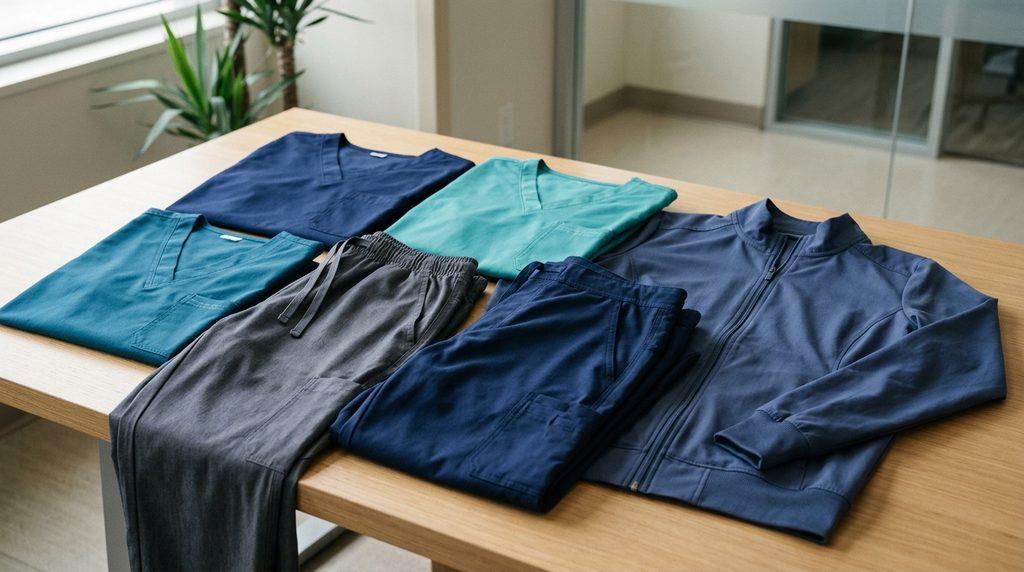
Scrub Tops
Having several scrub tops makes it possible to rotate colors and styles while maintaining a consistent work uniform.
Look for:
- Comfortable fit
- Appropriate neckline
- Useful pockets
- Suitable fabric
- Adequate coverage
- Freedom of movement
Scrub Pants
Pants should provide sufficient mobility through the waist, hips, thighs, and legs.
Depending on personal preference, options can include:
- Straight-leg pants
- Tapered pants
- Jogger styles
- Petite lengths
- Regular lengths
- Tall lengths
Scrub Jackets
A lightweight jacket can be useful when clinical environments are cool or when additional coverage is preferred.
Both women’s and men’s scrub jackets can serve as practical layering pieces when the workplace permits them.
Accessories
Depending on the profession, accessories may include:
- Nursing bags
- Medical backpacks
- Stethoscope cases
- Identification accessories
- Work organizers
The accessory selection should reflect actual daily requirements rather than simply adding more items to the wardrobe.
How Should You Choose Scrub Tops?
The top is one of the most visible components of a healthcare uniform, but appearance should not be the only consideration.
Evaluate:
Fit
The shoulders should allow natural movement, while the chest and torso should provide adequate room without excessive fabric.
Neckline
Common options include:
- V-neck
- Round neck
- Mock wrap
- Other contemporary styles
The workplace may have requirements regarding coverage or uniform appearance.
Sleeves
Short sleeves are common in many healthcare environments, while longer sleeves or approved layering options may be preferable in cooler settings.
Pockets
Consider whether pockets are actually useful for the items carried during the workday.
Fabric
Look for a balance of:
- Stretch
- Breathability
- Durability
- Softness
- Easy care
The best combination depends on the individual’s work environment.
How Should You Choose Scrub Pants?
Scrub pants need to support movement throughout the entire shift.
Pay attention to:
- Waistband comfort
- Rise
- Hip room
- Thigh room
- Leg shape
- Inseam
- Pocket placement
- Fabric stretch
Length is particularly important.
A pant that is too short can create an uncomfortable fit, while excessive length can interfere with movement.
Healthcare professionals may therefore benefit from having different length options available when their preferred fit requires them.
Should a Healthcare Uniform Be Loose or Fitted?
Neither extreme is ideal for everyone.
A very loose uniform can create unnecessary fabric and interfere with movement.
A very fitted uniform may restrict bending, reaching, sitting, or lifting.
A practical fit should provide enough room for movement while maintaining appropriate professional coverage.
The right fit also depends on the garment’s fabric.
A stretch fabric can provide more flexibility than a rigid fabric with the same apparent fit.
How Important Is Fabric Selection?
Fabric has a significant effect on how a uniform feels during a long shift.
Important characteristics include:
- Breathability
- Stretch
- Weight
- Durability
- Softness
- Wrinkle resistance
- Shape retention
- Ease of care
A professional who spends most of the day walking may prioritize breathability and stretch.
Someone working in a cooler environment may prioritize layering compatibility.
There is no single fabric that is best for every healthcare role.
What Makes Scrubs Comfortable for Long Shifts?
Long-shift comfort comes from several factors working together.
Appropriate fit
The uniform should not restrict movement or create unnecessary pressure points.
Breathable fabric
Materials that allow comfortable airflow can be useful during active work.
Stretch
Stretch can make bending, reaching, walking, and other movements easier.
Proper length
Tops and pants should remain appropriately positioned during movement.
Practical pockets
Useful storage can reduce the need to carry additional small accessories.
Appropriate layering
A removable layer can be more practical than wearing a heavy garment throughout the entire shift.
How Should You Build a Scrub Color Rotation?
Color selection should begin with workplace requirements.
Some healthcare facilities require specific colors for departments or roles.
Others allow more flexibility.
Once the permitted colors are known, a practical rotation can include:
- Primary work color
- Secondary approved color
- Additional backup sets
- Seasonal or personal-preference options where permitted
Maintaining a consistent color rotation can make it easier to organize uniforms before each shift.
If the workplace requires one specific color, purchasing multiple sets in that color is generally more useful than collecting several unrelated colors.
Why Is a Backup Uniform Important?
A backup uniform can be useful when unexpected situations occur.
Examples include:
- Spills
- Stains
- Damaged garments
- Unexpected schedule changes
- Extended shifts
- Laundry delays
A backup set can be kept at home, in an appropriate workplace storage location, or in another permitted location depending on workplace policies.
The purpose is simple: avoid being dependent on a single clean uniform.
How Many Scrub Tops Should You Have Compared With Pants?
The answer depends on how the garments are used.
Some professionals prefer matching sets, while others mix and match compatible tops and pants.
Having additional tops can provide more flexibility if:
- Tops become soiled more frequently
- Different tops are preferred with the same pants
- Multiple colors are permitted
- The tops have different pocket configurations
However, the wardrobe should still reflect actual usage.
There is little value in accumulating many tops if only a small number of pants are regularly worn.
Should You Own More Than One Type of Scrub Pant?
Having different pant styles can be useful when personal preferences change according to the workday.
For example, someone may prefer:
- Joggers for mobility
- Straight-leg pants for a traditional appearance
- Tapered pants for a contemporary silhouette
- Petite or tall lengths for a more precise fit
The most important factor is whether the workplace permits the selected style.
A wardrobe should prioritize the styles that provide the best combination of comfort and workplace compatibility.
Why Are Scrub Jackets Useful?
Healthcare facilities can have significant temperature differences between rooms, hallways, offices, and other work areas.

A lightweight jacket can provide an additional layer without requiring a completely different uniform.
Potential benefits include:
- Additional warmth
- Extra coverage
- Easy removal
- Convenient layering
- Additional pockets
A jacket can be especially useful for professionals who move between different environments during a long shift.
What Should You Look for in a Scrub Jacket?
Consider:
- Lightweight construction
- Comfortable fit
- Stretch
- Breathability
- Sleeve length
- Pocket placement
- Front closure
- Easy-care fabric
A jacket should also fit comfortably over the scrub top.
A jacket that is too tight can restrict shoulder movement, while an excessively oversized jacket can create unnecessary bulk.
How Should You Layer a Healthcare Uniform?
A practical layering system can be built around the expected environment.
One possible approach is:
Base layer → Scrub top → Lightweight scrub jacket → Outdoor outerwear when necessary
Not every professional needs all of these layers.
The important principle is flexibility.
A removable lightweight layer can help when temperatures change during the workday.
Healthcare professionals should also follow workplace requirements regarding additional clothing in clinical areas.
What Are Underscrubs?
Underscrubs are garments worn underneath a scrub top to provide additional coverage or warmth.
Depending on workplace requirements, they may include:
- Short-sleeve undershirts
- Long-sleeve undershirts
- Lightweight base layers
The fabric should be comfortable and should not create excessive bulk under the scrub top.
If the clinical environment has specific requirements for sleeves or visible layers, those rules should be followed.
How Important Are Pockets in a Healthcare Wardrobe?
Pockets can be useful, but more pockets do not necessarily mean a better uniform.
Evaluate:
- Location
- Depth
- Accessibility
- Security
- Weight distribution
A pocket should be practical for the items actually carried.
Overloading pockets can affect how a garment hangs and may create unnecessary weight.
What Accessories Complete a Healthcare Uniform?
Accessories vary according to profession and workplace.

Common examples include:
- Nursing bags
- Medical backpacks
- Stethoscope cases
- Identification accessories
- Work organizers
- Lunch or beverage containers
A nursing bag can provide organized storage for personal belongings and appropriate work accessories.
Professionals who commute may prefer a backpack with multiple compartments, while someone carrying fewer items may prefer a smaller bag.
Why Use a Stethoscope Case?
Professionals who regularly transport a stethoscope may benefit from dedicated storage.
A stethoscope carrying case can help keep the instrument separate from chargers, pens, keys, clothing, and other belongings.
This can be especially useful for:
- Nursing students
- Nurses
- Medical students
- Physicians
- Other healthcare professionals who commute with a stethoscope
The case should be appropriately sized and should not force the instrument into an excessively tight space.
How Should a Healthcare Uniform Wardrobe Be Organized?
Organization can make the daily routine considerably easier.
A simple system is to divide uniforms by:
Clean uniforms
Keep freshly laundered garments together and ready for use.
Workwear by color
If multiple approved colors are used, keep them separated.
Seasonal layers
Store heavier or lighter layers according to the season and workplace conditions.
Backup sets
Keep at least one backup uniform easily accessible.
Accessories
Store nursing bags, stethoscope cases, and other accessories in consistent locations.
The objective is to reduce the time spent deciding what to wear before a shift.
How Should You Plan a Healthcare Wardrobe Around Laundry?
Laundry frequency should influence how many uniforms you own.
If uniforms are washed after every shift, calculate how many workdays occur between laundry cycles.
For example:
5 shifts + 1 backup = 6 practical sets
Someone who washes more frequently may need fewer sets.
Someone who does laundry less frequently may need more.
It is also useful to account for drying time and unexpected laundry delays.
How Should Medical Scrubs Be Cared For?
Care instructions vary by fabric and garment construction.
Always follow the manufacturer’s care label.
Pay attention to:
- Washing temperature
- Drying method
- Bleach restrictions
- Ironing requirements
- Special detergent instructions
The Federal Trade Commission’s clothing care-labeling guidance explains the role of care instructions in helping consumers properly maintain covered textile products. FTC Clothing and Textile Care Labeling Rule
Following the garment’s specific instructions can help preserve color, fabric performance, shape, and construction.
How Can You Make Scrubs Last Longer?
Several everyday habits can help reduce unnecessary wear.
Follow the care label
Avoid assuming that every scrub garment should be washed or dried the same way.
Avoid unnecessary heat
Excessive heat can affect some fabrics and elastic components.
Do not overload the washer
Overcrowding can reduce effective cleaning and increase friction between garments.
Rotate uniforms
Using multiple sets instead of repeatedly wearing the same garments can distribute wear.
Address stains promptly
Treat stains according to the fabric and manufacturer’s recommendations.
Store garments appropriately
Clean, dry uniforms should be stored in a suitable environment.
Should You Buy Multiple Brands?
A healthcare professional can choose to use multiple brands if the workplace allows it.
Different brands may provide different combinations of:
- Fit
- Fabric
- Pocket configuration
- Stretch
- Color
- Style
However, mixing brands can create differences in color and fabric appearance.
If a consistent uniform appearance is important, choosing compatible collections or colors can provide a more cohesive look.
Should You Build a Wardrobe Around One Scrub Brand?
Not necessarily.
Some professionals prefer one brand because they already know how its sizing and fabrics fit.
Others may prefer different brands for different garment categories.
For example, one collection might provide preferred pants while another offers a preferred top.
The decision should be based on fit, workplace requirements, comfort, and personal preference.
How Should You Choose Workwear for Different Healthcare Roles?
Different roles can create different wardrobe priorities.
Nurses
Nurses may prioritize mobility, pockets, durable fabrics, and comfortable layers because of frequent movement and long shifts.
Physicians
Physicians may prioritize professional appearance, comfortable fit, and practical layering depending on their clinical environment.
Medical Assistants
Medical assistants may benefit from flexible uniforms that transition between clinical and administrative tasks.
Nursing Students
Students may need uniforms that comply with both educational and clinical-site requirements.
Dental Professionals
Dental professionals may prioritize easy movement and comfortable, professional workwear.
Veterinary Professionals
Veterinary workers may place greater emphasis on durability, mobility, and easy-care fabrics.
These are general considerations rather than universal requirements. Each workplace can have its own dress code and equipment policies.
How Should You Build a Healthcare Wardrobe on a Budget?
A practical wardrobe does not need to be built all at once.
Start with the essentials.
Phase 1: Core uniforms
Purchase enough scrub sets for the regular work schedule.
Phase 2: Backup
Add one or two additional sets for unexpected situations.
Phase 3: Layering
Add a lightweight jacket or other approved layer if needed.
Phase 4: Accessories
Add a nursing bag, medical backpack, or equipment case based on actual requirements.
Phase 5: Specialty pieces
Only add additional styles, colors, or garment types when there is a genuine need.
This approach prioritizes frequently used items over a large collection of rarely worn pieces.
How Can You Build a More Versatile Scrub Wardrobe?
Versatility comes from choosing garments that work across multiple situations.
Consider:
- Neutral or workplace-approved colors
- Compatible tops and pants
- Layering pieces
- Multiple lengths where needed
- Practical pocket configurations
- Easy-care fabrics
A versatile wardrobe can reduce the number of garments required while still providing enough options for a full work schedule.
What Should You Avoid When Building a Healthcare Uniform Wardrobe?
Buying Too Many Styles at Once
It is better to determine which fits and fabrics work before purchasing large quantities.
Ignoring Workplace Requirements
A garment may be comfortable but still unsuitable for the workplace.
Buying Without Checking Sizing
Sizing can differ between manufacturers and garment styles.
Prioritizing Appearance Over Function
A professional appearance matters, but the uniform must also support movement and comfort.
Ignoring Laundry Frequency
Too few uniforms can create unnecessary pressure when laundry is delayed.
Buying Too Many Accessories
Accessories should solve real organizational problems rather than simply increase the amount of equipment carried.
Complete Healthcare Uniform Wardrobe Checklist
| Wardrobe Element | What to Consider |
| Scrub tops | Fit, neckline, sleeves, pockets, fabric |
| Scrub pants | Waist, inseam, leg style, pockets, stretch |
| Backup sets | Unexpected schedule changes and spills |
| Scrub jackets | Layering, warmth, fit, mobility |
| Underscrubs | Coverage, warmth, workplace requirements |
| Lab coats | Role, length, pockets, professional requirements |
| Nursing bag | Capacity, organization, carrying comfort |
| Medical backpack | Commuting, storage, device protection |
| Stethoscope case | Fit, padding, portability |
| Colors | Workplace requirements and personal preference |
| Laundry | Frequency, drying time, care requirements |
| Storage | Organization of clean and backup garments |
How Do You Know When Your Healthcare Wardrobe Needs an Upgrade?
A wardrobe may need updating when:
- Garments no longer fit properly.
- Fabric has become excessively worn.
- Elastic has lost its recovery.
- Colors have significantly faded.
- Zippers or closures no longer work correctly.
- The existing wardrobe does not cover the current work schedule.
- A new workplace has different uniform requirements.
- The professional’s preferred fit or work role has changed.
Replacing garments based on actual wear is generally more practical than replacing an entire wardrobe at once.
Where Can Healthcare Professionals Shop for Uniforms and Accessories?
Healthcare professionals can evaluate workwear based on their role, workplace requirements, preferred fit, and daily routine.
A broad medical uniforms selection can provide a starting point for evaluating different types of professional workwear.
For those who prefer online shopping, medical scrubs online can make it easier to review available categories, styles, colors, and sizes before making a purchase.
For professionals who prefer to evaluate fit and fabric in person, visit a medical uniform retailer to explore available workwear and accessory options.
Frequently Asked Questions
How many sets of scrubs should a healthcare professional own?
The appropriate number depends on the work schedule and laundry frequency. A practical starting point is enough sets to cover the shifts between laundry cycles, plus at least one or two backup sets for unexpected situations such as spills, stains, or schedule changes.
What should a healthcare uniform wardrobe include?
A basic wardrobe can include multiple scrub tops and pants, one or more backup sets, an approved layering piece such as a scrub jacket, and practical accessories such as a nursing bag or stethoscope case when needed. The exact combination depends on the profession and workplace.
What makes scrubs comfortable for long shifts?
Comfort generally comes from an appropriate fit, breathable fabric, useful stretch, suitable garment length, practical pockets, and the ability to layer when necessary. No single feature guarantees comfort, so the complete garment should be considered.
Should healthcare professionals have different scrub styles?
Different styles can be useful when they address different needs. For example, a professional may prefer jogger pants for mobility, traditional pants for a more conventional appearance, or different tops for varying coverage and pocket requirements. Workplace rules should always be considered.
How can you make medical scrubs last longer?
Follow the garment’s care instructions, avoid unnecessary heat when the care label recommends otherwise, rotate multiple sets, address stains appropriately, and store clean garments in a suitable environment. Proper care can help preserve fabric performance and garment construction.
Is a scrub jacket necessary?
A scrub jacket is not necessary for every healthcare professional, but it can be useful in cool clinical environments or when additional coverage is desired. A lightweight jacket can provide an easily removable layer without requiring heavier outerwear.
Conclusion
Building a healthcare uniform wardrobe is less about owning a large number of garments and more about having the right combination of workwear for the actual demands of the job.
A practical wardrobe starts with enough scrub tops and pants to cover the regular work schedule. Backup sets provide flexibility when unexpected spills, schedule changes, or laundry delays occur. Fit, fabric, mobility, pocket design, and garment length should all be considered when selecting those core pieces.
Layering can make the wardrobe more adaptable. A lightweight scrub jacket or approved underscrub can provide additional comfort in changing temperatures without requiring a completely different uniform.
Accessories can also contribute to an efficient work routine. Nursing bags, medical backpacks, and stethoscope cases can help organize the items that travel between home, school, and the workplace.
Most importantly, the wardrobe should reflect the individual’s actual role and workplace requirements. Uniform colors, garment styles, visible layers, and equipment can all be subject to facility-specific rules.
A well-planned healthcare wardrobe ultimately reduces unnecessary decisions and provides reliable options for the workday. By prioritizing comfort, functionality, durability, and appropriate professional appearance, healthcare professionals can create a collection of workwear that supports them throughout demanding shifts.